
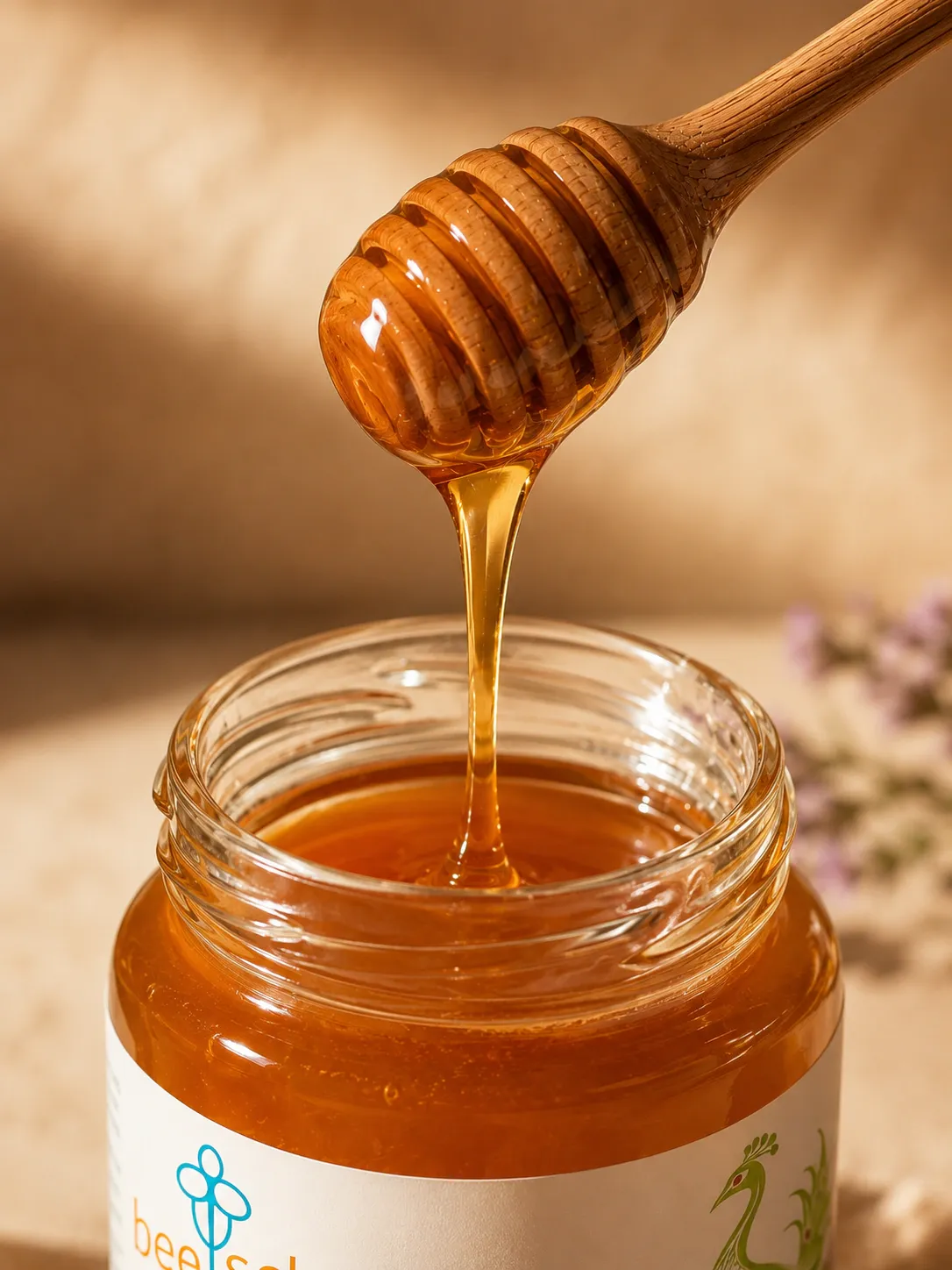
It is the question we hear most often in our shop, and it usually comes with a test someone saw online: drop honey in a glass of water, hold a flame to it, smear it on your thumb. The honest answer is less exciting. No kitchen test can prove that honey is pure. What does help is knowing where to look, and whom to ask.
Why the home tests do not work
Most home “purity tests” measure one thing: how thick the honey is. Thickness depends mainly on how much water the honey holds, on the temperature of the room and on the variety. It says nothing about whether syrup was added, or where the honey really came from.
- The water glass. Pure honey is said to sink and stay in a lump, while fake honey dissolves. In fact any thick syrup sinks too, and a perfectly genuine honey with a little more water spreads faster. Cold water slows everything down.
- The flame. A match dipped in honey is supposed to light only if the honey is pure. What decides it is moisture: a damp match will not strike, whatever it was dipped in.
- The thumb. A drop that holds its shape is meant to be pure, and a drop that runs is meant to be fake. Yet a fresh orange blossom honey runs more than a thick oak honey, and a warm day thins both. A syrup can be made just as thick.
- The paper. Honey on kitchen paper is not supposed to leave a wet ring. Again, this only shows the water content, which a well-made syrup copies easily.
Honey fraud today is not a spoonful of sugar stirred into a jar. It is industrial syrup made to look, pour and even taste like honey, and it passes every one of these tests. That is why a test that “proves” purity can give you false comfort.
What really tells you something
You cannot measure the honesty of honey with a glass of water. You can, however, put the odds on your side. These are the signs we would look for ourselves.
- A source you can trace. Good honey has a story you can check: the variety, the place, the season, the beekeeper. Ask where it was made and when it was harvested. A seller who knows the answer will be glad to tell you.
- The country of origin on the label. EU rules require every jar to name the country where the honey was produced. Since June 2026, a blend must list each country with its share; older jars may still say “blend of EU and non-EU honeys”. If you want Greek honey, the label should say Greece, and only Greece.
- Crystallisation. Most genuine honeys set over time, some within weeks, some only after many months. It is a natural process, not a sign of added sugar. It is not proof either: pine and fir honeys can stay runny for a long time. Read more in why honey crystallises.
- A sensible price. Thyme honey from Greek hillsides takes real work and comes in limited amounts. A large jar of “Greek thyme honey” at a syrup price deserves a few questions.
What a laboratory can see
Real proof needs a specialist laboratory. Pollen analysis shows which plants the bees visited, and so the botanical and often the geographical origin of the honey. HMF, a compound that rises when honey is heated or stored for a long time, shows how it was handled. The sugar profile and isotope checks reveal many added syrups.
Authorities and large buyers rely on these methods. They cost money for every sample, so they are not something you can do at home. Even they work best with traceability, which means knowing the path of the honey from hive to jar, to catch the cleverest fraud.
Pure and raw: what the words mean
“Pure” means nothing has been added: no syrup, no sugar, no honey from a country other than the one on the label. “Raw” goes one step further. It means the honey was not heated or finely filtered after extraction, so it keeps its natural aroma, texture and pollen.
EU law does not define the word “raw”, so it rests on the honesty of the producer. That is one more reason to buy from people you can talk to.
Our honey, and how to judge it yourself
All the honey we sell is 100% Greek. Our own Beesclepious honey is raw, never heated and unfiltered, and we pack it in small batches. Our thyme honey comes from Mount Kithaironas, the Mani and Crete, our pine honey from Euboea, and our fir and oak honeys from the mountains of Corinthia. Each variety, with its region and season, is in our honey guide.
The best test is still your own palate. Come to our honey shop at Asklipiou 24 in central Athens, taste the varieties side by side and ask us anything about where they come from. Opening hours and directions are on our visit page.


